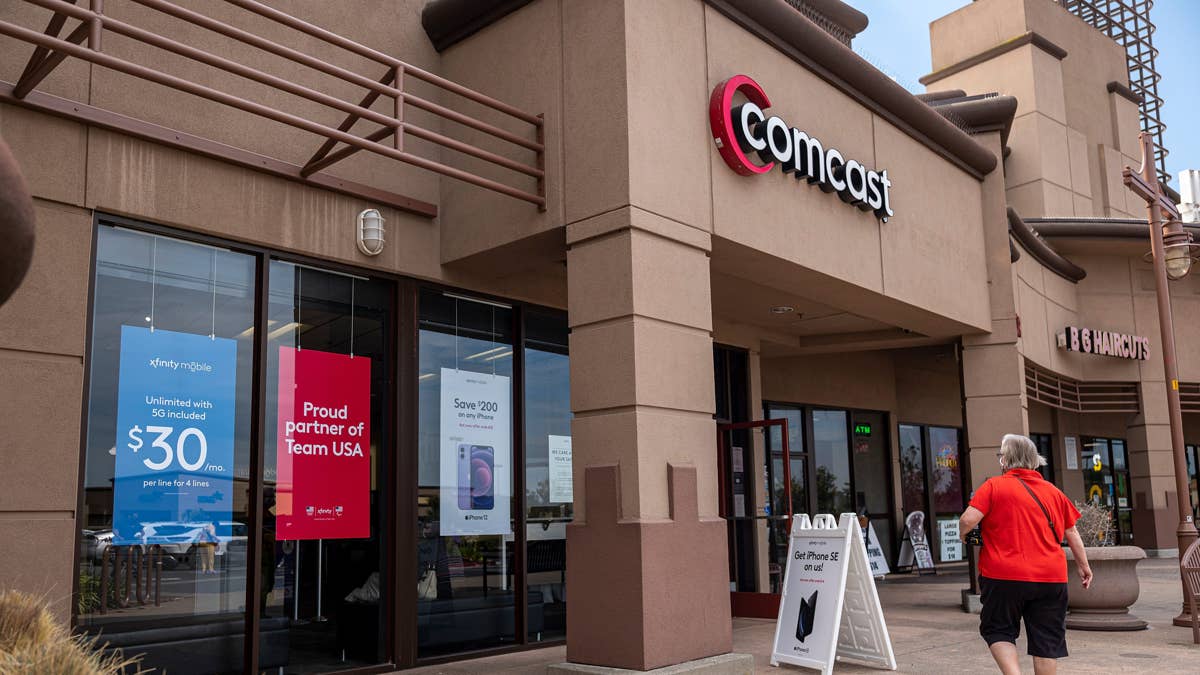
Comcast Chief Financial Officer Jason Armstrong is issuing a stern warning about broadband pricing and the company’s future performance as it continues to lose a significant number of customers.
In 2025, Comcast, which operates broadband service under the name Xfinity, lost over 700,000 internet customers after raising Xfinity prices and restricting its autopay discount. The trend continued, with the company losing a combined 232,000 internet customers across the first and second quarters of this year.
On an earnings call in July, Armstrong said that the company is operating in an “intensely competitive” market.
“Fiber continues to expand, fixed wireless remains aggressive, satellite is emerging as another alternative, and convergence-based promotional activity remains elevated across the industry,” he said.
Comcast CFO warns about “irrational” fiber internet pricing
At the Goldman Sachs Communacopia + Technology Conference on Sept. 9, Armstrong has warned that the company is seeing “irrational” pricing from fiber internet rivals, a trend that began in the first half of this year.
“We were starting to see irrational competition,” said Armstrong. “It popped up a little bit in the second quarter. I would tell you it’s continued into the third quarter.”
“So when we see fiber pricing, standalone fiber pricing, in the $30-$40 range for a gig, when we say irrational, that’s what we mean by irrational,” he continued. “That to us is not a rational price point.”
Related: Comcast adds new service to internet plans as customers leave
Armstrong said that the transition from copper to fiber costs Comcast “potentially thousands of dollars,” causing him to question the $30-$40 pricing. Currently, Comcast charges roughly $50 per month for its fiber-powered internet (a hybrid fiber-coaxial network) at 1 Gbps speed.
He also flagged that rivals are rapidly increasing their fiber internet build in Comcast’s markets, further intensifying competition.
“If you look at fiber making its way into our markets, historically, we would see overbuild of 2%-3% per year,” he said. “That’s accelerated in the last couple of years. It looks more like 4% or 5% at this point.”
As fiber internet operators accelerate their growth and offer lower-priced plans to consumers, Armstrong warned that Comcast doesn’t expect customer losses to improve in the third quarter of this year.
“We do think a full year we’ll improve our broadband subscriber losses,” he said. “I think quarters are going to look different within that. This particular quarter, I don’t think we’ll improve year over year. So the pressure we’ve seen, in particular with irrational fiber pricing, is going to cause that.”
Comcast faces growing pressure from fixed wireless and satellite
Fiber isn’t the only growing threat to Comcast’s business. Fixed wireless internet, which is usually offered by mobile providers at lower prices than traditional wired internet, is becoming increasingly popular among U.S. consumers.
“Fixed wireless continues to be a pressure on subscriber additions,” said Armstrong. “That’s no different from the past several years.”
Satellite internet providers are also gaining steam in the broadband market. For instance, SpaceX’s Starlink surpassed 12 million global high-speed internet customers so far this year. Armstrong said that while satellite internet isn’t a major threat to Comcast at the moment, this could change over time.
“Satellite looms out there as a potential threat,” he said. “Would reiterate what we said on the second-quarter call, not really seeing it yet, but there’s no complacency around it. I think we’ll see it over time and, in particular, in rural and maybe deep suburban markets, it may be a better option as a competitor than we’ve faced historically.”
Despite intensifying competitive headwinds, Armstrong said that wired internet still “wins.”
“If you think about the ability to increase speeds over time, if you think about lowest latency, if you think about lowest marginal cost to upgrade, all those sort of bring you back to you want a wire in the home,” he said.
Comcast navigates cautious consumers, bets on company split
Armstrong’s bleak outlook on broadband competition and on Comcast’s near-term performance in the industry comes as more consumers nationwide are opting to switch internet providers amid rising prices.
A survey from Reviews.org in March found that 73% of Americans have seen their internet service bills inflate this year, with 30% facing monthly increases of $10 to $20.
Hidden fees and unexpected charges are influencing internet customers’ decisions, as roughly
67% said this has caused them to either change providers or consider switching. Meanwhile, higher prices have led 30% of Americans to cancel their home internet service or move to a lower-tier plan over the past year.
More Telecom News:
- T-Mobile excludes 2 generous customer perks from new phone plans
- Comcast eyes acquisition of 33-year-old rival amid struggles
- Spectrum makes significant decision as customer losses mount
Tim Tincher, a media relations specialist at Reviews.org, said in a press release that pricing significantly impacts customer retention in the broadband industry.
“People want internet pricing to be simple and honest,” said Tincher. “Instead, many are dealing with rising bills, surprise fees, and confusing charges. When customers feel caught off guard, they’re much more likely to start looking for another provider.”
As Comcast faces a more price-conscious consumer, it announced in June that it plans to split into two companies in mid-2027. This includes separating its media and entertainment assets, including NBCUniversal and Sky, from its cable business, which provides broadband, wireless and cable TV services under the name Xfinity.
Former Comcast CFO Michael Angelakis will rejoin the company as CEO of the retained cable business. Armstrong said this change will help fuel growth into its broadband, cable TV and wireless services.
“For the remaining cable co., it’s also a forcing function,” said Armstrong. “How many things can we go reinvent? Where are the pockets for growth that we can just be more agile, more focused? There’s a lot of different things out there we’re looking at.”
In a research note in July, MoffettNathanson analyst Craig Moffett said that Angelakis’ main task will be to “find balance” to turn around Comcast’s struggling broadband segment, according to a report from Light Reading.
“Yes, broadband sub trends clearly need to improve,” said Moffett. “But the improvement can’t come solely from cutting prices.”
He added that the goal “isn’t to ‘lose less.’ And it’s certainly not to ‘lose less’ if the cost of the price reductions is greater than the benefit to net additions.”
“But, as we noted last quarter, turnarounds must start somewhere,” he continued. “It’s not unreasonable to be at least a little optimistic.”
Related: Comcast hopes generous offers will slow internet customer losses